
Energetics - Thermal transmittance
A fundamental role at the energy level for our buildings is represented by thermal transmittance, but what is it and how is it calculated?
Thermal transmittance, which in this article we will call by the letter H, is a physical quantity that measures the amount of thermal power exchanged by any body, in contact on both sides with fluids (air or water), per unit of surface and unit of temperature difference, considering the temperatures of the fluids in contact with the wall as different. We can therefore state that thermal transmittance represents the ability of a body to exchange energy and be traversed by a thermal flow, and in the International System it is measured in W/m²K.
The assumptions underlying the calculation of thermal transmittance include the "steady state" regime, that is, the velocity of the fluid is considered constant at every point in contact with the body. Thermal transmittance is a fundamental factor for the energy performance of a building, since based on the calculated transmittance values, it will be possible to determine the amount of energy needed to reach and maintain a given comfort temperature inside a building.
Transmittance varies according to the physical characteristics of the material making up the body in contact with the fluids, and to the different types of heat exchange, such as:
- conduction (heat transfer between two bodies in contact);
- convection (heat transfer between a body in contact with a fluid);
- radiation (heat transfer by means of electromagnetic waves).
Returning to the definition of thermal transmittance, this is the amount of heat that, in the unit of time, passes through the unit of surface, when the temperature difference between the two faces is one degree Kelvin. The empirical formula for calculating the thermal transmittance of a flat wall is as follows:
H= 1/Rt [W/m²K]
H= Thermal transmittance
Rt= Thermal resistance
Rt= R1+R2+R3+...Rn
R1, R2, R3, ..., Rn= Thermal resistance of the various layers making up the wall
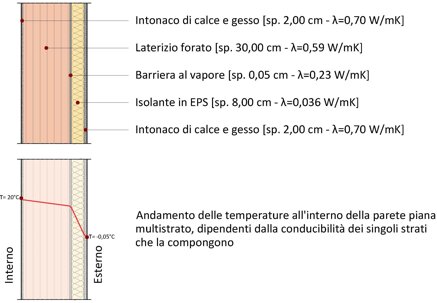
Thermal resistance, in detail, is the ability of a material to oppose the flow of heat that tends to pass through it. Each individual layer of a wall will have a resistance equal to:
Rn= s/λ [m²K/W]
λ= thermal conductivity [W/mK];
s= thickness of the material in meters [m].
Thermal conductivity can be easily obtained from specific material tables or from manufacturers' technical data sheets.
At this point you can easily tackle the simple calculation of the transmittance of your infill walls and check whether or not they comply with the most recent energy regulations, which set specific limits, varying according to the thermal zone in which the element to be calculated is located, the opacity or otherwise of the body (distinguishing between infill walls and windows) and the type of construction (new or existing).