
STRUCTURAL ANALYSIS - Seismic risk
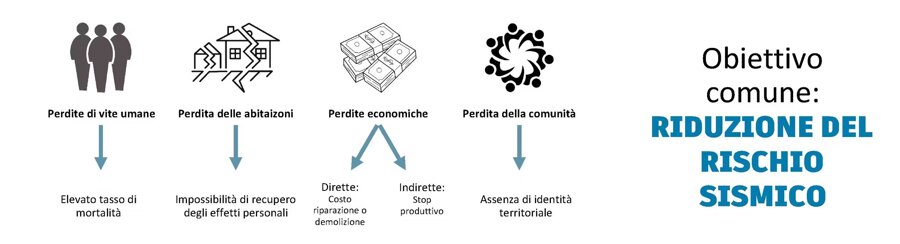
Safety during catastrophic earthquake events starts with the building—do you know about seismic risk?
Speaking of seismic engineering, for several years now there has been talk of "seismic risk", which is often misunderstood in common language as the concept of "hazard".
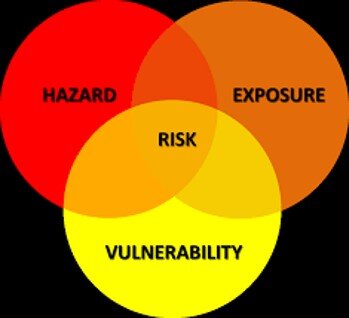
In reality, seismic risk is the product of three components, all fundamental:
RISK = HAZARD x VULNERABILITY x EXPOSURE
Seismic risk represents the measure of losses caused by an earthquake in a given place, over a given period of time. It therefore expresses a probabilistic measure of what could happen in the event of seismic events.
- HAZARD: probability that an event of a certain intensity will occur in a given place, over a given period of time.
- VULNERABILITY: probability that a certain level of damage will occur as a result of a given seismic event, therefore it depends on the design of the building, and for this reason it is the only one of the three parameters on which it is possible to intervene.
- EXPOSURE: probable consequences from an economic and social point of view caused by the damage, so it concerns the "importance" of the structure, but also the population density or the historical value of a building.
Therefore, a building located in a place with high seismic hazard, built according to the most recent and updated seismic engineering standards, could have a much lower risk than a building constructed with outdated construction techniques, with very limited knowledge in the field of seismic engineering, located in a place with lower seismicity.
The determination of the seismic risk of a building is fundamental to have a forecast of what could happen during a seismic event; the higher the risk, the greater the chances of damage/collapse of the building itself. To reduce seismic risk, it is necessary to analyze the three components; it follows that there is no possibility of intervention on hazard and exposure, as this would mean changing the location and intrinsic characteristics of the building, while the only component that can be acted upon is vulnerability.
Intervention on vulnerability consists of increasing the building's performance in terms of its capacity to withstand the phenomena produced by an earthquake without being damaged. Having a highly performing building means avoiding damage or collapse and thus saving human lives during major seismic events.
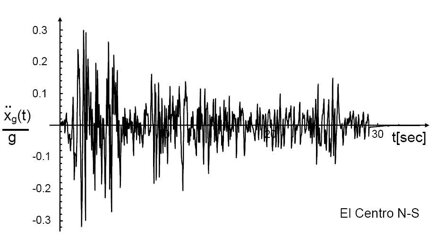
El Centro earthquake accelerogram of 1940
Accelerogram of the 1940 El Centro earthquake